Best Demolition Safety Practices Boynton Beach
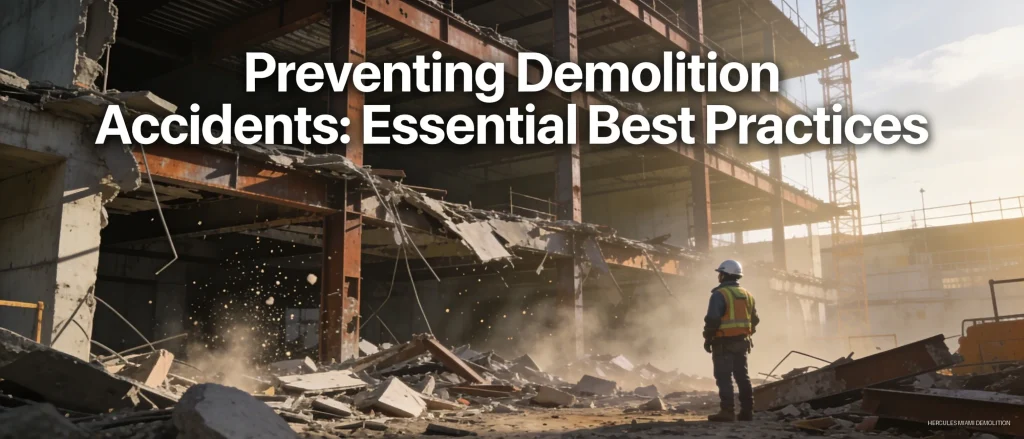
Preventing Demolition Accidents: Essential Best Practices
By Superior Demolition Contractors Editorial Team · Updated 2026-07-14
Proper pre-task planning, hazard assessments, and strict OSHA compliance are the most effective best practices to prevent demolition accidents. Since construction accounts for nearly 1 in 5 workplace fatalities nationally, demolition crews must conduct thorough structural surveys, ensure utility disconnection, and enforce PPE requirements before any work begins.
Preventing demolition accidents requires thorough pre-project planning, strict OSHA compliance, and hazard identification before work begins. Construction fatalities occur at nearly three times the national average rate, per Bureau of Labor Statistics data. Proper personnel training, controlled teardown methods, and site protection measures eliminate the most dangerous conditions demolition crews face. Superior Demolition Contractors serves property owners, developers, and general contractors across the Miami area (including Boynton Beach, FL), applying these standards on every project.
Key Takeaways
- OSHA requires a thorough structural survey before any demolition work begins on a site.
- Demolition fatality rates run nearly 3 times higher than the average across all industries.
- Workers must de-energize, disconnect, and cap all utility lines before demolition crews start.
- Superior Demolition Contractors enforces strict PPE protocols on every job site in Cutler Bay, FL and Boynton Beach, FL.
Demolition vs. Standard Construction: Understanding the Greater Risk
Demolition carries hazards that standard construction work does not, because crews are dismantling structures whose structural integrity is already compromised. The best practices for demolition safety exist precisely because the risks are not theoretical. They are documented, fatal, and preventable.
Construction already ranks among the top five deadliest industries in the United States, with a fatality rate nearly three times higher than the national average, according to the Bureau of Labor Statistics. Demolition layers additional danger on top of that baseline. Workers are not building something stable; they are taking apart something unstable. That distinction drives every safety protocol on a compliant demolition site.
Common Fatality Types on Demolition Sites
Real demolition deaths follow a grim pattern. Workers have been impaled on exposed rebar, electrocuted during active teardowns, and killed when roofs collapsed beneath aerial lifts. Two workers died of burns after a flash fire broke out at a warehouse demolition. These are not edge cases; they are recurring incident types that safety planning directly addresses.
OSHA’s data consistently shows that the four leading causes of construction-industry deaths (falls, struck-by incidents, electrocutions, and caught-in/between hazards) account for more than 60 percent of all fatalities in the sector. Demolition sites concentrate all four categories simultaneously, which is why demolition hazard prevention demands a higher standard of pre-task planning than most other construction activities.
Demolition vs. General Construction: Worker Risk Compared
Nearly one in five workplace deaths across all U.S. industries in 2022 occurred in construction, according to Bureau of Labor Statistics data. Demolition sits at the more hazardous end of that already dangerous spectrum. The core reason is structural unpredictability: a building being torn down can shift, collapse, and expose hidden hazards at any stage of the work.
In South Florida communities such as Boynton Beach and Miami-Dade County, older building stock adds another layer of complexity. Structures built before modern codes often contain undocumented load-bearing configurations, legacy electrical systems, and hazardous materials that require identification and abatement before mechanical teardown begins.
Key demolition-specific hazard categories include:
- Structural instability from weakened load-bearing elements
- Electrical hazards from live or improperly disconnected utilities
- Falling debris from overhead work and partial collapses
- Hazardous materials disturbed during teardown, including asbestos, lead paint, and silica dust
- Noise and vibration exposures that accumulate over multi-day projects
- Confined space hazards when crews work inside partially demolished structures
Essential Pre-Project Planning Steps for Demolition Safety
Best practices for demolition safety begin long before a single wall comes down. Thorough pre-project planning identifies hazards, establishes controls, and protects every worker on site from preventable harm. OSHA’s demolition standards under 29 CFR 1926 Subpart T make pre-demolition engineering surveys a legal requirement, not a recommendation, before any structural work begins.
Superior Demolition Contractors structures every project around a defined workflow that starts with a consultation to capture objectives and constraints. Whether the project is in Boynton Beach, Cutler Bay, or elsewhere in the Miami area, only after that foundation is set does the team move into safety planning, regulatory compliance, and controlled execution. Skipping any early step creates gaps that surface as accidents later.
The Critical Role of a Job Hazard Analysis
A Job Hazard Analysis (JHA) is the cornerstone of pre-demolition planning. Crews that conduct a JHA before work begins identify and assess risks systematically, then develop targeted safety controls for each one. Anticipating problems on paper costs nothing; discovering them mid-demolition costs schedules, budgets, and sometimes lives.
A thorough JHA for a demolition project should identify:
- The structural load paths most likely to shift during teardown
- Underground and overhead utility locations and disconnection requirements
- Hazardous material locations (asbestos, lead, PCBs) requiring abatement before demolition
- Equipment access routes and swing-radius conflict zones
- Emergency evacuation paths and muster points
Key Elements of a Site Safety Plan
A Site Safety Plan (SSP) translates the JHA findings into actionable protocols that crews follow from day one. A well-defined SSP makes any project significantly safer by establishing clear procedures before workers ever arrive on site.
Key elements addressed during pre-project planning include:
- Structural assessment to understand load paths and collapse risk
- Utility identification and disconnection to eliminate electrocution and gas hazards
- Hazardous materials review, including asbestos-related scopes that require compliant handling before demolition proceeds
- Equipment selection matched to the structure’s size and location constraints
- Neighbor and environmental protection measures to limit disruption to adjacent properties
- Permit acquisition to meet local building department requirements before work starts, including Palm Beach County requirements for Boynton Beach projects
- Emergency response protocols, including on-site first aid access and hospital routing
Addressing hazardous materials considerations early is non-negotiable. Asbestos and similar substances demand compliant methods before any mechanical work begins. Integrating those scopes into the broader demolition plan keeps the project on schedule and the site safe.
Safety Responsibility on a Demolition Site
Responsibility for demolition site safety flows from the licensed contractor to every crew member on site. The contractor is legally accountable for OSHA compliance, proper permitting, and the safety of subcontractors operating within the project perimeter. Site supervisors must conduct daily pre-task safety briefings, verify PPE compliance, and halt work immediately when unexpected hazards (such as unmarked utilities or unanticipated structural movement) are encountered.
On projects in Boynton Beach, FL and throughout Palm Beach and Miami-Dade counties, local permitting offices may impose additional requirements beyond federal OSHA minimums. A licensed contractor familiar with regional codes ensures nothing falls through the cracks.
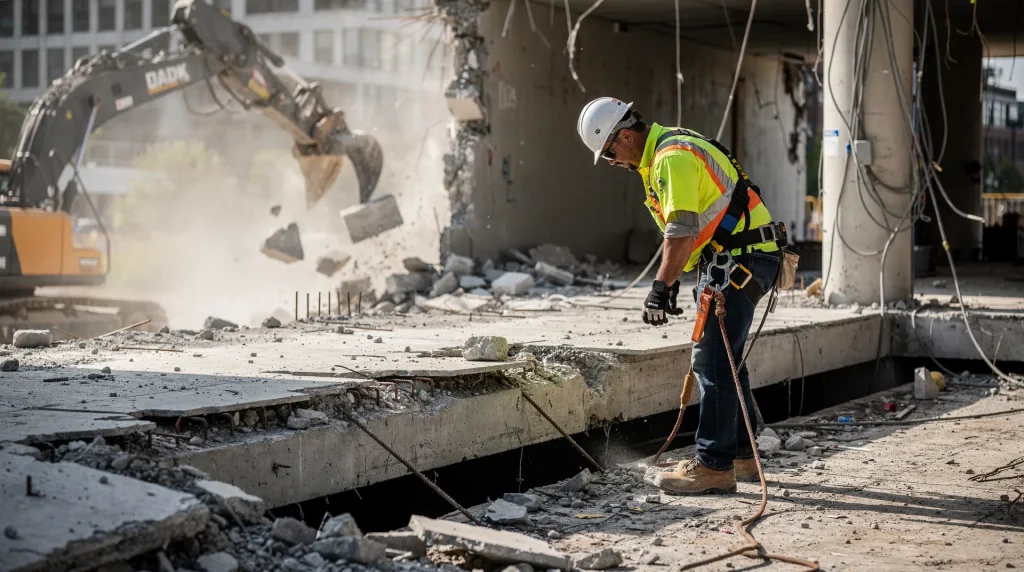
OSHA's Fatal Four on Demolition Sites
OSHA identifies four leading causes of construction fatalities: falls, struck-by incidents, electrocutions, and caught-in/between hazards, collectively known as the Fatal Four. Demolition sites amplify every one of these risks because workers operate on weakened structures, around swinging equipment, and near exposed utilities simultaneously.
The Fatal Four don’t just threaten individual workers. Each hazard category represents a failure point that cascades into project delays, liability exposure, and regulatory penalties. Preventing accidents requires understanding exactly how and why each hazard occurs before a single wall comes down.
OSHA's Core Demolition Standards
OSHA demolition standards are governed primarily by 29 CFR 1926 Subpart T: Demolition. These regulations require:
- An engineering survey by a competent person before any demolition begins, to assess structural stability and identify potential collapse zones
- Utility disconnection: all gas, electric, water, steam, and sewer lines must be shut off or controlled at the street before work starts (OSHA 1926.702)
- Hazardous material identification: inspections for asbestos, lead, silica, and similar substances before mechanical demolition
- Floor load ratings to be checked before equipment is moved into or operated on any level of the structure
- Stairways and passageways kept clear and illuminated as long as any workers remain in the structure
- PPE compliance enforced throughout all phases of work, with specific respiratory protection required near dust-generating activities
Non-compliance with these standards triggers citations, stop-work orders, and, in willful violation cases, fines that regularly exceed $15,000 per violation under OSHA’s updated penalty schedule.
How Each Fatal Four Hazard Manifests on a Demolition Site
Each Fatal Four category takes on a distinct character on a demolition site that separates it from a standard construction context. Falls become more likely as crews work on floors that have lost structural integrity and stairways that are progressively removed. Struck-by incidents escalate when mechanical equipment swings through areas where wall sections are already weakened and can shed material without warning. Electrocution risk is highest at the start of a project, before utilities are fully confirmed as de-energized — a single missed disconnect on an older Boynton Beach or Miami-Dade property can be fatal. Caught-in/between hazards peak during the later phases of teardown, when heavy machinery operates inches from partially standing walls that can shift under vibration. Understanding how each hazard behaves in the demolition context is what separates a compliant pre-task plan from a generic one.
Controlling and Eliminating Demolition Hazards
Demolition hazards are controllable and eliminable with the right combination of proper planning, appropriate personal protective equipment (PPE), crew training, and strict OSHA compliance. No hazard is inevitable. Superior Demolition Contractors treats regulatory compliance and careful planning as non-negotiable commitments on every project, not optional add-ons. The firm applies proven techniques and disciplined site-protection measures to keep the Fatal Four from becoming fatal outcomes across its service area, from Cutler Bay to Boynton Beach, FL.
Key controls for each Fatal Four category:
- Falls: Guardrails, fall-arrest systems, and floor-opening covers on all elevated work areas
- Struck-by: Exclusion zones around equipment swing paths and debris drop areas; hard hats and high-visibility vests required at all times
- Electrocutions: Utility locates and lockout/tagout procedures before demolition begins; all electrical panels de-energized and locked out
- Caught-in/between: Strict equipment-to-worker proximity rules, structural shoring, and barricading of partially demolished walls
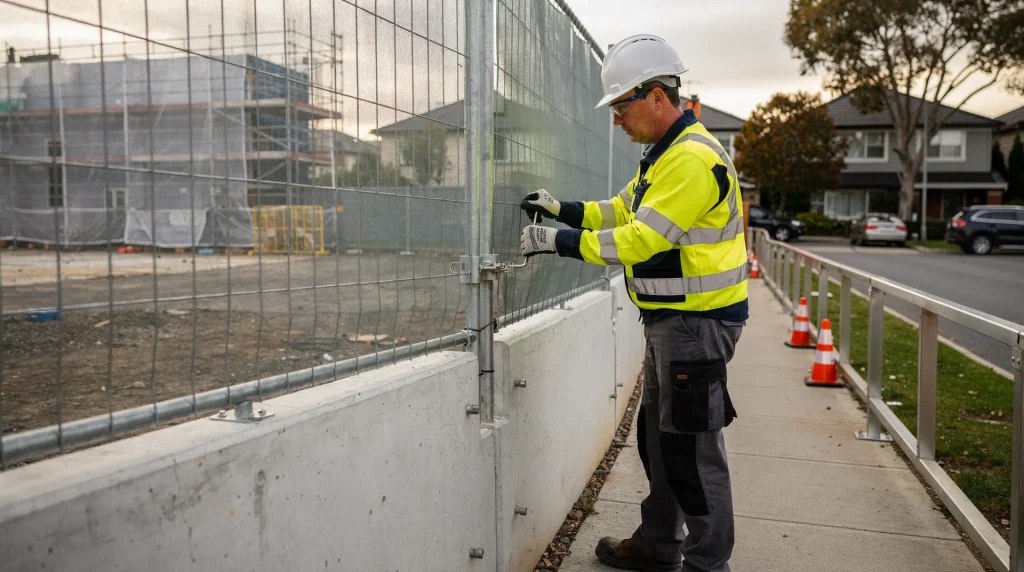
Required PPE for Demolition Sites
Demolition PPE requirements are among the most comprehensive in the construction industry, reflecting the wide range of hazards crews encounter across a single shift. OSHA mandates specific personal protective equipment for demolition work, and licensed contractors enforce those requirements as a baseline, not a maximum.
Standard Demolition PPE Requirements
Every worker on an active demolition site must be equipped with the appropriate PPE for the hazards present. Core demolition PPE includes:
- Hard hats (Class E): protect against falling debris and electrical hazards; required at all times within the work perimeter
- Safety glasses and face shields: shield eyes and face from concrete fragments, dust, and flying debris during mechanical demolition
- High-visibility vests: ensure workers are visible to equipment operators at all times, reducing struck-by risk
- Steel-toed, puncture-resistant boots: protect feet from rebar punctures, dropped material, and compression hazards
- Cut-resistant gloves: required during manual debris handling and rebar exposure
- Hearing protection: mandatory when noise levels exceed 85 dB, which is typical during jackhammer and heavy equipment operations
- Respiratory protection (N95 or higher): required whenever dust-generating activities occur, and P100 respirators or supplied-air systems are mandatory during confirmed asbestos or lead abatement work
- Full-body fall-arrest harnesses: mandatory for any work above six feet where guardrails are not feasible
Elevated PPE Requirements for High-Risk Scopes
Certain demolition scopes trigger elevated PPE requirements beyond the standard kit:
- Asbestos-containing materials (ACM): OSHA 1926.1101 requires full HAZMAT suits, supplied-air respirators, and negative-pressure enclosures during removal
- Lead paint demolition: EPA RRP rules and OSHA 1926.62 require lead-rated respirators and disposable coveralls
- Silica-generating activities (concrete cutting, grinding): OSHA’s Respirable Crystalline Silica Standard (1926.1153) mandates engineering controls and appropriate respiratory protection
- High-voltage work zones: Arc-flash-rated PPE and rubber insulating gloves are required when working in proximity to energized equipment
A licensed demolition contractor like Superior Demolition Contractors maintains a site-specific PPE matrix for every project, whether in Boynton Beach, Cutler Bay, or across Miami-Dade, ensuring the right equipment is available, fitted correctly, and enforced consistently before any crew member enters the work zone.
Site Protection Measures for Workers and Neighbors
Best practices for demolition safety require disciplined site protection at every stage of a project. Careful planning, proven techniques, and structured safeguards protect adjacent structures, workers on the ground, and the surrounding environment from the hazards demolition generates.
Injuries and fatalities on demolition sites do more than cause human suffering; they disrupt project timelines, drive up costs, and damage a contractor’s reputation in ways that are difficult to recover from. Site protection is not a courtesy. It is a business-critical priority that determines whether a project finishes on schedule and within budget.
Superior Demolition Contractors builds site protection into every phase of a project, from initial consultation through final cleanup. The company’s mission centers on completing every project to high safety standards while minimizing disruption to clients and neighboring properties, a commitment that shapes how crews plan barriers, control debris, and manage equipment movement on tight urban lots in communities like Boynton Beach, FL.
Licensing and Insurance as Site Safety Foundations
Operating as a fully licensed and insured contractor (LIC.#CGC1523237) directly reduces risk for everyone connected to a project. Clear processes and verified credentials keep schedules on track and deliver reliable outcomes, giving property owners and neighboring residents confidence that the work meets regulatory standards.
Elements of a Disciplined Site Protection Plan
A structured protection plan typically addresses several parallel priorities:
- Adjacent structure safeguarding: assessing and shielding neighboring buildings before work begins
- Environmental controls: managing dust, debris, and runoff to protect the surrounding area
- Crew safety protocols: enforcing personal protective equipment and controlled demolition sequencing
- Regulatory compliance: aligning every scope of work with applicable codes and permit requirements, including those specific to Palm Beach County for Boynton Beach projects
Together, these measures transform a high-risk demolition site into a controlled, predictable operation.
How a Licensed Contractor Reduces Demolition Risk
Hiring a licensed demolition contractor directly lowers project risk by ensuring regulatory compliance, disciplined safety planning, and accountability at every stage. A licensed contractor carries verified credentials and insurance coverage, which protects property owners from liability when unexpected site conditions arise.
Best practices for demolition safety begin before a single wall comes down. Contractors operating under a valid license follow defined workflows, from initial consultation through final debris removal, that keep hazards controlled and schedules intact. Superior Demolition Contractors holds license number CGC1523237 and maintains full insurance coverage, giving clients in Boynton Beach, FL and across the South Florida region a documented layer of protection that unlicensed operators simply cannot offer.
Risks of Hiring an Unlicensed Demolition Contractor
Unlicensed contractors skip the compliance steps that prevent structural collapses, utility strikes, and hazardous material exposure. They typically bypass required engineering surveys, neglect proper permitting, and operate without the insurance that protects property owners from liability. When something goes wrong, and it frequently does without proper planning, the property owner can be left financially and legally exposed.
A safe worksite is a productive worksite, and implementing effective safety measures ensures compliance with industry regulations, both outcomes that depend on a contractor who is legally accountable for the work performed.
Equipment Quality and Crew Experience in Safety Outcomes
Experience and equipment quality are not interchangeable with licensing, but they reinforce it. Superior Demolition Contractors deploys modern equipment and experienced crews across jobs ranging from single-family homes to large office and industrial buildings. Matching the right machinery to the structural type reduces the risk of uncontrolled collapses and damage to neighboring properties.
The company’s service range covers full-structure demolition, selective and interior demolition, concrete demolition, land clearing, and pool demolition, each requiring a different combination of equipment, technique, and safety protocol. That breadth of experience translates directly into safer outcomes on complex projects in Boynton Beach, FL, Cutler Bay, and throughout the Miami metropolitan area.
Questions Property Owners Should Ask Before Hiring
Owners and developers can reduce risk at the hiring stage by asking the right questions upfront:
- Is your contractor’s license current and does it cover this type of demolition work?
- Does the contractor carry general liability and workers’ compensation insurance?
- Will the contractor obtain all required permits before work begins?
- What is the protocol if hazardous materials are discovered mid-project?
- How does the contractor protect neighboring structures and properties from damage?
- Can the contractor provide references from comparable projects in Boynton Beach or the surrounding area?
Key advantages licensed contractors provide:
- Regulatory compliance verified through active licensure
- Insurance coverage that protects clients from liability exposure
- Proven equipment scaled to the project’s structural demands
- Permit management from application through final inspection
- Responsive communication from estimate through final site cleanup
Property owners and developers in Boynton Beach, FL and across the Miami area can request a free estimate by calling Superior Demolition Contractors at 786-829-7727 or through the website at miamidemolition.net to begin the compliance-first planning process.
Frequently Asked Questions
Why is demolition more dangerous than standard construction work?
Demolition crews dismantle structures with already compromised structural integrity, creating unpredictable collapse risks. Construction fatalities occur at nearly three times the national average rate across all U.S. industries, and demolition sits at the more hazardous end of that spectrum due to structural unpredictability, hidden utilities, and disturbed hazardous materials.
What steps protect workers before demolition begins?
OSHA requires an engineering survey by a competent person before any demolition work begins. Workers must also de-energize, disconnect, and cap all utility lines, complete a Job Hazard Analysis, establish a Site Safety Plan, and confirm that all required permits are in place before teardown starts.
What types of fatal incidents occur on demolition sites?
Workers have been impaled on exposed rebar, electrocuted during active teardowns, and killed by roof collapses beneath aerial lifts. Flash fires have caused fatal burns during warehouse demolition projects. All four of OSHA’s Fatal Four — falls, struck-by incidents, electrocutions, and caught-in/between hazards — are present simultaneously on active demolition sites.
What PPE is required for demolition workers?
Demolition workers must wear hard hats, safety glasses, high-visibility vests, steel-toed boots, cut-resistant gloves, and hearing protection at minimum. Respiratory protection (N95 or higher) is required for dust-generating activities. Asbestos and lead abatement work requires full HAZMAT suits and supplied-air respirators under OSHA 1926.1101 and 1926.62.
What OSHA standards govern demolition work?
Demolition work in the United States is primarily regulated under OSHA 29 CFR 1926 Subpart T. This standard covers engineering surveys, utility disconnection, floor load ratings, stairway safety, and PPE requirements. Additional standards apply for asbestos (1926.1101), lead (1926.62), and respirable silica (1926.1153).
What are the most common causes of demolition accidents?
The most common demolition accident causes are inadequate pre-task planning, failure to disconnect utilities before work begins, lack of proper PPE, inadequate structural assessment, and the use of unlicensed or underqualified contractors who skip required compliance steps.
How can property owners verify a demolition contractor is licensed in Florida?
Florida contractor licenses can be verified through the Florida Department of Business and Professional Regulation (DBPR) online license lookup. Superior Demolition Contractors holds license number CGC1523237 and maintains full insurance coverage for residential and commercial demolition projects across Miami-Dade County, Palm Beach County including Boynton Beach, FL, and surrounding communities.
Does Superior Demolition Contractors serve Boynton Beach, FL?
Yes. Superior Demolition Contractors serves property owners, general contractors, and developers in Boynton Beach, FL and throughout South Florida, including Miami-Dade and Palm Beach counties. The company applies the same licensed, insured, and compliance-first approach to every project regardless of location. Contact the team at 786-829-7727 or visit miamidemolition.net to request a free estimate.